Training courses on sustainable sanitation by German Toilet Organization

GTO training course

The German Toilet Organization (GTO), in cooperation with Women in Europe for a Common Future (WECF) and the GIZ program “Sustainable sanitation – ecosan”, offers two training courses (basic and advanced) in Germany for NGO workers and interested parties who want to acquire or deepen their knowledge on sustainable sanitation and the planning and implementation of sanitation projects.

The basic course “Toilets for schools and public buildings in developing countries” (PDF; 0.2 MB) takes place on 11-12 February 2012 in Iffeldorf, near Munich and the advanced course on “Sustainable solutions for sanitation in developing and countries in transition” (PDF; 0.2 MB) takes place on 3-4 March 2012 in Berlin. Both courses will be held in German.

Mainstreaming proprietary software formats into dev aid publications

Mainstreaming the Environment into Humanitarian Action

Dear Readers,
as much as I would like to share the following link to a very nice training toolkit with you – a toolkit that has been up online for some time now and recently got an extra section on sustainable sanitation – I am seriously wondering what the good folks at UNEP’s Environment, Humanitarian Action and Early Recovery programme are doing all day long. Probably not anything related to knowledge management & IT.

“UNEP and Groupe URD have developed a training toolkit to assist humanitarian actors to integrate environmental considerations into their policy development, planning, programme design and operational activities. The training toolkit consists of 11 modules, with each substantive module containing a summary, PowerPoint presentation, trainer’s guide, training materials and key supporting documents.” (src)

I know it isn’t good style to publicly criticize others, but producing a toolkit that consists of documents saved in DOCX, PPTX or WMV format just isn’t appropriate in any way. This may work for those in charge behind their desks in Europe or the US, but not out there in the field.

Instead, all documents should rather be in Portable Document Format (PDF). Along with a free & light-weight portable PDF viewer. There are quite a few out there with open licences.  And the videos – how about AVI instead of Windows (!) Media Video (WMV)? Or Theora? And a portable VLC player for MS Win, OSX and Linux.

How many dev workers in Africa are on Apple computers due to the malware threat? Right.

This publication is just an example. In fact, there are many others – yes, even in 2012 – that are produced in a similar way and which make me think that there’s no real passion behind it. This issue probably wouldn’t arise if everything was accessible via the web – which could also be displayed on small mobile phone screen, instead of 48 MB *.pptx files. Maybe we also have to blame ourselves for producing PDFs that can be shared on- and offline, but whose content would be much better in old-fashioned html.

An example of a passionate project is Alex Weir’s CD3WD collection. That’s much more information than any one of us can handle, yet it’s all usable.

What do you think?

Urine diversion dehydration toilets after Typhoon Sendong in the Philippines

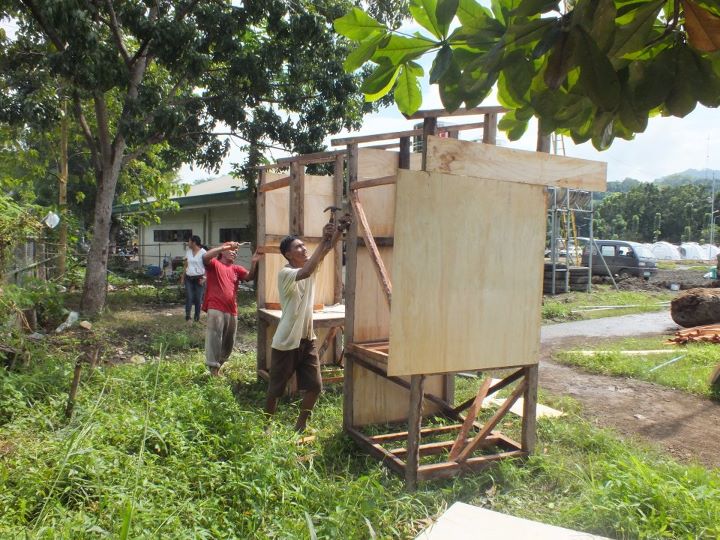
Elmer Sayre of WAND Foundation today sent us the following update from Cagayan de Oro City and Iligan Cities, Philippines where a small team of volunteers quickly set up urine diversion dehydration toilets (UDDTs) as emergency response after a recent typhoon.

As Elmer reports:

“Typhoon Sendong was so severe and fierce, hitting at 2 a.m. when most people were asleep, erasing in the map entire communities, scattering the living in various evacuation centers and  open spaces. When the water system of Iligan and Cagayan de Oro cities was damaged and most flush toilets in the affected areas were wiped-out, the ecosan* solution is left as one of the most viable options. I asked support from friends and classmates and social network acquaintances and built and deployed portable ecosan toilets focusing mainly on the evacuation centers housing 7,000-12,000 people.”

The blue area is the river running through Cagayan de Oro. The green areas are the totally devastated communities, with water up to the 2nd floor of houses at 2 am while most are sleeping. The city could not account for all the dead and missing especially that most of those living in or near the river banks are informal settlers. Isla de Oro as shown here is full of these shanty houses. Now it is tragically devoid of anything.

“When we started on the 21st December, 3 days after the typhoon, the stench of human feces in the evacuation centers were too much and fecal matter is everywhere. Now we have contained it and we are racing against time to build some more units especially for people living scattered around open spaces without sanitation facilities. Our team do constant monitoring and collection of human waste and store it in our facilities in Libertad to be processed later on as fertilizer for coconut trees.”

Constructing urine diversion dehydration toilets on the run-down to New Year at Tent City, Iligan, Philippines

“We are doing well and in fact, today, a Swiss humanitarian aid agency asked us to supply them with 35 portable ecosan toilets for evacuation centers in Iligan city.”

For more information on Elmer’s work, please see these two documentations “Philippines Flashflood Documentation” (PDF; 0.9 MB) and “Briefer Ecosan Wand” (PDF; 0.4 MB) or feel free to directly contact WAND Foundation on their website.

*ecosan => here:  Urine diversion dehydration toilets (UDDTs)

This is a cross-post which initially appeared on the SuSanA working group 8 blog on “Sustainable Sanitation in Emergency and Reconstruction“.

Harnessing the wisdom of crowds: Open discussion forum helps to answer many sanitation related questions

The following is a guest post by GIZ ecosan team leader, Dr. Elisabeth von Münch:

Harnessing the wisdom of crowds: Open discussion forum helps to answer many sanitation related questions

The idea for this open discussion forum on sanitation came from our experience that when you want to buy a new car or have a question about your baby’s teeth: where do you get advice from? You put your question into a search engine like Google and you end up reading other people’s postings on a discussion forum. Usually, those questions and answers prove to be very helpful.

SuSanA-forum-header

The same mechanism can hold true for a discussion forum on sanitation issues. This is why the Sustainable Sanitation Alliance (SuSanA) secretariat developed a new discussion forum which was launched in July 2011. The forum is open – as opposed to some existing closed fora which require a login even just for reading. Today, the SuSanA forum already has 930 registered users, 40 topics, nearly 1000 views for the most popular topics, and some topics have attracted up to 20 replies.

All postings are readable by everyone and searchable by search engines like Google and Yahoo. A broad range of topics are covered such as sanitation systems and technologies, health and hygiene, CLTS, school sanitation, sanitation systems for special conditions, menstrual hygiene management, SuSanA working groups and announcements and many more.

All registered users can contribute to the forum by creating new discussion topics or by responding to the posts of others. The option to create a user profile, including a passport-style photo, is available. The user can also attach additional documents and photos to his or her posts.

For people who like to receive postings via e-mail, it is also possible to subscribe to a daily e-mail alert service of new posts simply by leaving your e-mail address here. Alternatively or in addition, one can subscribe to specific categories or topics after logging in and thereby follow specific discussions.

Here are four examples of very active discussion threads so far:
Faecal sludge management
Mobile sanitation systems like peepoo bags in Kenya or a new urine diversion toilet pot in Bangladesh
Menstrual Hygiene Management, including the Ruby Cup business idea in Kenya
Progress of SuSanA working groups

To view the discussion forum or to obtain your own login for writing on the forum, please click here: www.forum.susana.org

For further information or questions please contact the SuSanA secretariat.

Teaching with Compendium Cards

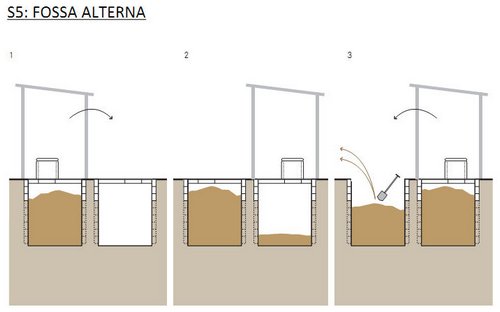
In an update to the wonderful “Compendium of Sanitation Systems and Technologies“, Christian Zurbrügg of Eawag/Sandec today informed us of Compendium Cards which are now available in English, French and Spanish:

s5-fossa-alterna

“Each card corresponds to the one of technologies listed in the Compendium and can be printed out in a large format for group work, presentations or games. (…) By printing out each technology on a coloured card, you can build a colour-coded set of technologies to visualize, build and modify sanitation systems. Laminated cards made of heavy coloured paper can be used for games, taped to walls or held by group members as they select and link technologies into a feasible system.”

Great!