Who Gives A Crap

Written by jke on September 23, 2010 – 11:21 pm -

The good part about running a blog instead of being a journalist is that you can write about stuff you really like and also insert your own opinion as well as asking your readers for their comments. This obviously happens outside the conventional (dev aid) world with its often streamlined, corporate communication policies which sometimes avoid mentioning open issues like the following initiative which I read about today in the recommendable EcoSanRes mailing list.

If you’re interested in sustainable sanitation issues, make sure not to miss out this valuable exchange on first hand experiences with participants from all over the world. Yes, it’s just an old-fashioned mailing list that will sometimes clog up your inbox, but it’s the tool people use to communicate (hello 2010, hello RSS feeds, hello blogs, hello Facebook, hello Twitter, hello LinkedIn/Xing…).

You’ll notice that I took this wonderful headline as an opportunity to include my 2c in the beginning because it’s something I’ve been meaning to mention on this blog for a long time. Also, if YOU feel like there’s a story that needs to be published here, please feel free to contact me and I will have a look at it. Thank you!

Now back to the main topic: “Who Gives A Crap“.

Who Gives A Crap actually is a very interesting and thought-provoking initiative that aims to support water & sanitation projects in the developing world via the sale of sustainable toilet paper.

Yes, this may sound like a joke because a) what’s (environmentally) “sustainable toilet paper”?, b) why only focus on developing countries? (~ developing in which sense? within the watsan/sanwat sector? hmm..) and c) the guys behind this are otherwise busy running “a website that fundraises for development aid organisations using internet advertising”.

Nevertheless, as the distinguished Professor Ralf Otterpohl from the Institute of Wastewater Management and Water Protection @ Technische Universität Hamburg-Harburg (Germany), pointed out in an e-mail reply today (on this said mailing list): [they are] “…touching an important issue. The cultural gap between washers and wipers shows that both sides are doing something strange.”

I couldn’t agree more. Both, using only dry paper OR only water with your bare hands aren’t sustainable solutions. Yes, people have been practising each method for ages, and probably everyone has perfected his/her own method of anal cleansing over the years and will teach/show his/her children accordingly – but are these methods really sustainable?

Wet toilet paper? Ralf goes on arguing that wet toilet paper is “not suitable for wastewater treatment plants of vacuum blackwater systems”. Ha! I am a huge fan of vacuum systems and wet toilet paper, but this revelation is something new to me. No wonder the toilet paper on planes (=> vacuum toilets)  is so thin and instantly dissolves. Also note that there are different types of wet toilet paper.

So with the situation being that we currently have many different sanitation systems all over the world (toilets, and the wastewater treatment, if any), and humans that are increasingly travelling all over the globe within hours, expecting similar standards all over the world, it begs the question if there is one unique and sustainable system that will fit everyone…(?).

One system for everyone. One toilet system – seat or squatting toilet & one cleaning procedure -  but obviously different treatment systems, adopted to the local climate/conditions (water, electricity, maintenance, etc.). Will this be possible? And is it a desired solution?

I don’t know if these are the right questions to ask when it comes to the complex matter of sanitation & treatment options, but then: how come we’re looking for sustainable treatment and reuse options if the cleansing process itself – the “interface” between users and a toilet – already is an unsolved issue by itself? And also part of the problem?

Ralf Otterpohl goes on telling us about the Terra Preta Sanitation (TPS) that partly consists of a disposable “food-quality” cleaning cloth, moistured with a lactid acid bacteria. Hey, doesn’t that sound like the desired sustainable toilet paper? And “food-quality” already sounds like a very smart Cradle2Cradle approach.

Terra Preta Sanitation (TPS) is a low-cost dry sanitation system based on urine diversion and the addition of charcoal to the system that produces lasting and highly fertile soils with properties similar to the recently [re]discovered manmade Terra Preta (black soil) in the Amazon region. Through natural processes of lacto-fermentation (silage) and vermicomposting, fecal material is converted into Terra Preta like soils that can be utilized in (urban) agriculture and also act as a carbon sink. (source)

Terra Preta Sanitation, a system designed for use in urban areas, with a separate collection of used toilet paper in a bucket. I already like the concept and that it has been re-discovered as a traditional method.

Wait….! You were first talking about sustainable toilet paper and now you’ve switched to a sustainable treatment system for urban areas that generates fertile soils? How’s that supposed to mix up? And why should I Give A Crap??!

Because you should. It starts with eating and doesn’t stop when you go to the toilet. There needs to a working closing-the-loops system in place that helps us grow food and also provides a secure and comfortable way for hygiene standards. Wet toilet paper that adds value to a system, if you will.

Coming back to the video above: would you buy (any) sustainable toilet paper and fork out an extra dime for it?

And: would you be willing to switch your existing cleaning method for any new – better – option? (similar to the already popular & separate collection of glass, paper and bio waste, which also required some behaviour change…)


Tags: , , , , , ,
Posted in action, multimedia, Terra Preta | 1 Comment »

Practical Guidance on the Use of Urine in Crop Production

Written by jke on September 10, 2010 – 12:44 am -

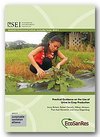
ecosan-urine-in-crops-100824-web-1In a collaborative process within the Sustainable Sanitation Alliance Working Group 05 on Food Security and Productive Sanitation Systems, the Stockholm Environment Institute (SEI) recently published a “Practical Guidance on the Use of Urine in Crop Production”.
This book gives practical guidance on the use of urine in crop production as a vital component of sustainable crop production and sanitation systems. It also includes guidance on how to start activities that will facilitate the introduction of new fertilizers to the agricultural community. This general sourcebook is for professionals, extension workers and practitioners in the field of agriculture, water and sanitation and should serve as a support tool for the development of locally adapted guideline versions.

The publication is available as a PDF (1.7 MB)


Tags: , , , , ,
Posted in publications, urine | No Comments »

Seminar/Training on Sustainable Sanitation for German NGOs

Written by jke on September 9, 2010 – 7:40 pm -

An increasing number of German NGOs are showing interest in implementing sustainable sanitation within their projects. In order to support these efforts the German Toilet Organization (GTO) in cooperation with gtz-ecosan will be offering a two day seminar on the 23rd and 24th of October 2010 at the GTZ headquarters in Eschborn, Germany. A further seminar – supported by LEZ Berlin – will be offered in Berlin on 27th and 28th of November 2010.
(c) Sustainable Sanitation Alliance

The aim of the training sessions is to discuss how specific technological solutions and sociological approaches can be applied, as well as giving an insight into the particular problems that may serve to hinder successful project implementation. Focus will be on sanitation systems and hygiene awareness raising for schools and public facilities in developing countries.

For more information (in German) or to register, please visit the GTO homepage: www.germantoilet.org and see the following PDF (in German, 0.1 MB).

Updates concerning the seminar will be posted here (in German):
http://www.germantoilet.org/en/projects/ngo-training.html


Tags: , , , , ,
Posted in ecosan, events | No Comments »

toilet signs & gender segmentation

Written by jke on September 3, 2010 – 3:08 pm -

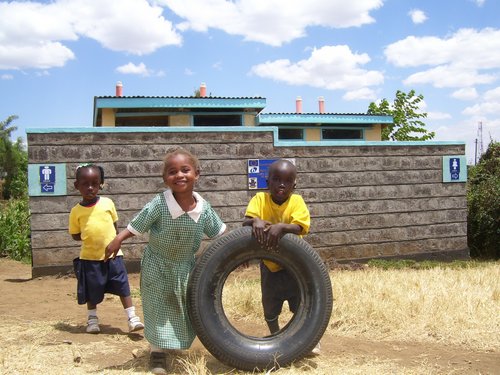
wo-menSpeaking about sanitation, most people probably just think of toilets and how to improve on that. And while we rather think about the involved process engineering (aka the technical side) associated with this daily business, the toilet, it’s availability and cleanliness is what is seen by the majority.
It is against this background that I would like to forward you to this interesting post on gender and toilets (also here because of the additional comments) as there’s still a complete world full of such unsolved gender issues.

Fortunately, or at least that’s what I think, any debate on toilets (~sanitation, ~hygiene, ~privacy, ~comfort, etc.) is good & a way forward into the right direction. So if it takes a gender issue like the rather unfortunate (or not?) seperation into women’s and men’s washrooms for people to return talking about toilets, then we’re one step closer to an improved sanitation. Do you agree?


Tags: , , ,
Posted in awareness | No Comments »

water supply & sanitation map in Africa

Written by jke on September 1, 2010 – 12:18 pm -

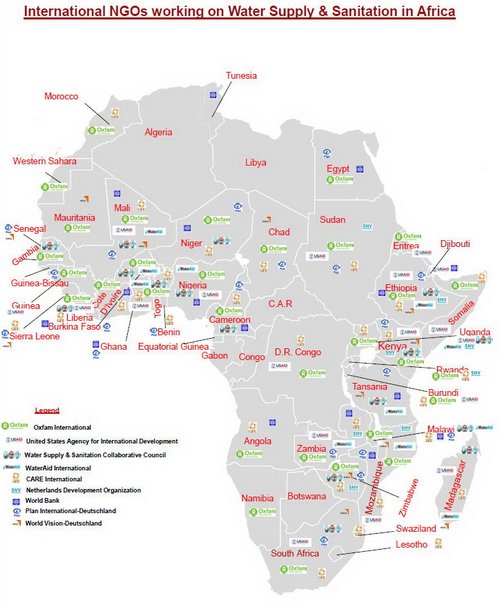
During a recent trip to the GTZ office of the “sustainable sanitation – ecosan” program in Eschborn, Germany, I stumbled upon the following interesting map that display various international NGOs working on water supply & sanitation issues in Africa.

gtz-ecosan-01092010-int-ngo-watsan-africa-map.pdf


download this map as a PDF (0.1 MB)

Steffen Blume of GTZ-ecosan, who created this map for his colleagues at work & agreed to share this with us, kindly asks for some feedback in return. So if you’re active or know of an active NGO within the water / sanitation sector that isn’t listed here, please directly send your feedback to Steffen Blume or kindly use the comment form below. Thank you!


Tags: , , , ,
Posted in publications | 1 Comment »